
Outdoor Lighting
Landscape Design
Lighting Design
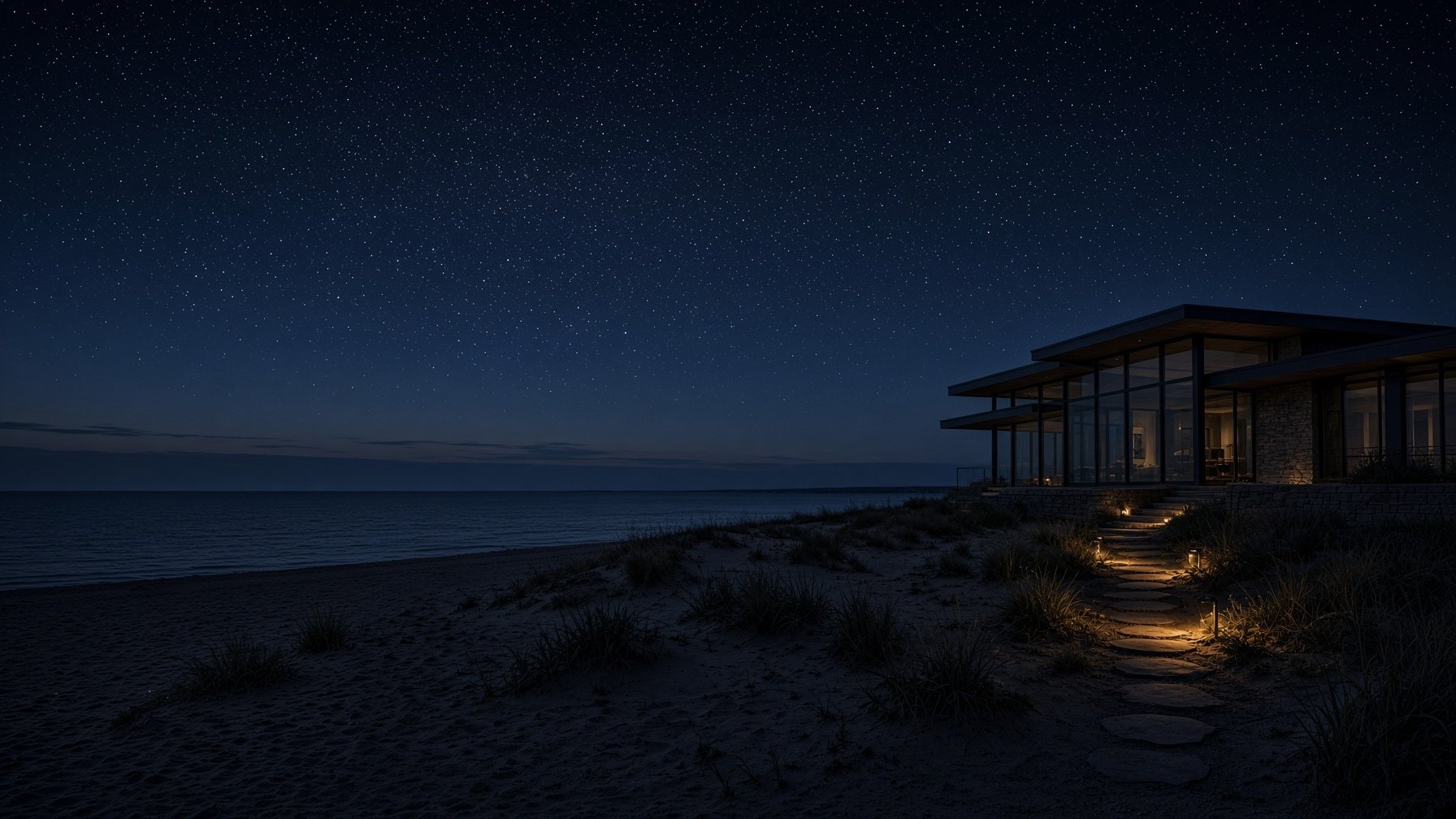

Wildlife-friendly lighting for a home next to a beach, preserve, park, or open land is lighting that stays on the task, stays low and shielded, and avoids short-wavelength white and color. Nesting sea turtles orient to the brightest, bluest horizon. Birds, insects, amphibians, and nocturnal mammals use darkness as cover and as a clock. The design job is the same in both places—aim, shield, dim, warmer spectrum—with a stricter cap on anything that faces habitat.
What wildlife-friendly means on any lot
It is not a fixture style and it is not only a coastal rule. It is a set of behaviors for light that can reach habitat.
If a product page only says “warm LED,” it has not answered this question.
Coastal lots: turtles and the seaward face
Sea turtles come ashore to nest and hatchlings crawl toward the brightest horizon. Historically that horizon was the sky over water. Artificial light inland competes with it. Cool-white and RGBW “party” color are the worst offenders because they are bright and short-wavelength. Even a well-meant landscape layer can become a trap if it faces the ocean or reflects off glass.
Turtle lighting and Dark Sky work overlap but are not identical. Dark Sky is about uplight, glare, and skyglow. Turtle work adds direction to the water and spectrum. A beautifully shielded 3000K uplight on a seaward palm can still be the wrong lamp in season.
California coastal cities, Florida counties, and some HOAs write this into permit language. Read the ordinance for that lot. Do not assume a “Dark Sky fixture” checkbox satisfies a wildlife-lighting clause.
Inland lots: preserves, parks, and open land
A house that backs to a wildlife corridor, a regional park, an oak woodland, a wetland, or agricultural open space has the same geometry problem without salt air. Light that leaves the property becomes trespass into habitat. That affects more than turtles.
What typically goes wrong inland is not a single flood on the beach. It is a ring of path hats along the rear property line, unshielded wall lanterns on the view terrace, and tree uplights aimed through the fence into the dark. From the preserve those lamps are a hard edge of night-turned-day.
Animals do not all fail the same way, but the lighting mistakes rhyme:
HOAs next to open space, park-interface overlays, and some California hillside or habitat-conservation rules treat this as light trespass plus wildlife. Ask planning staff whether the lot sits in a wildlife overlay before you copy an inland luxury plan onto the rear setback.
A practical spec: work from habitat inward
Whether the habitat is a beach or a park, start at the edge that faces it and work back toward the house.
Habitat-facing facade, terrace, and rear setback
Default is off during sensitive hours, or true amber at very low output, fully shielded, no uplight. Do not graze a glass wall that looks at the water or the canyon. If the architecture needs a night presence, put it on the street or courtyard elevation.
Paths and steps that lead toward the edge
Recessed or fully louvered marks at the tread. Amber on coastal dune walks. 2700K high-CRI is often acceptable on an inland side path that cannot be seen from the preserve—confirm that with a night walk from the habitat, not from the kitchen. No decorative hats in a line that reads as a runway.
Street, motor court, and house-facing garden
Still shield and dim. You can often use 2700K high-CRI (90+, typically around 93) here because the habitat does not see it. High CRI is a specifier choice so stone and planting read correctly. It does not make a lamp wildlife-safe if the lamp faces the park.
Color-changing RGBW
Leave it off the habitat-facing zone. Saturated blue and white scenes are the opposite of this brief. If the client wants color, confine it to the courtyard and not during restricted hours.
Controls
A photocell that slams every zone to full at dusk works against you. Separate the habitat-facing zone. Give it a seasonal schedule, a curfew, or a physical cutoff. Motion on a rear flood is not a landscape layer. It is a startle device aimed at the very edge you are trying to keep dark.
Solid brass or copper housings matter on the coast and in any climate that strips paint, because salt, fog, and irrigation destroy painted aluminum first. That is durability, not wildlife science. A brass fixture aimed at the dune or the oak woodland is still a problem. Material keeps the housing on the wall; aim and spectrum keep habitat dark.
What people get wrong
Where this shows up on a job
A coastal brief is often a custom house with glass toward the water and a garden the owners want after dinner. The daylight rendering shows uplights in the seaward beds and a row of path lights to a lookout. After dark, from the beach, the house reads as a bright box and the path is a dotted line inland. The finish is usually: kill or amber-shift the seaward layer; keep 2700K high-CRI on the motor court and landward planting; replace decorative hats on the dune walk with shielded treads; put the seaward terrace on its own zone with a seasonal off window.
An inland brief looks similar with different nouns. A ridge house backs to a county preserve. The rear terrace wants grazing on the view wall and path lights along the fence. From the trail after dark those lamps are a hard white line. The finish is the same geometry: habitat-facing zone off or amber and shielded; house-facing layers kept; no uplight through the fence; a curfew instead of dusk-to-dawn.
Custom brass or copper can match the architecture on the landward or street walls without adding another glowing object to the horizon. Walk the habitat edge. If you can see the lamp, the design is not done.